Method
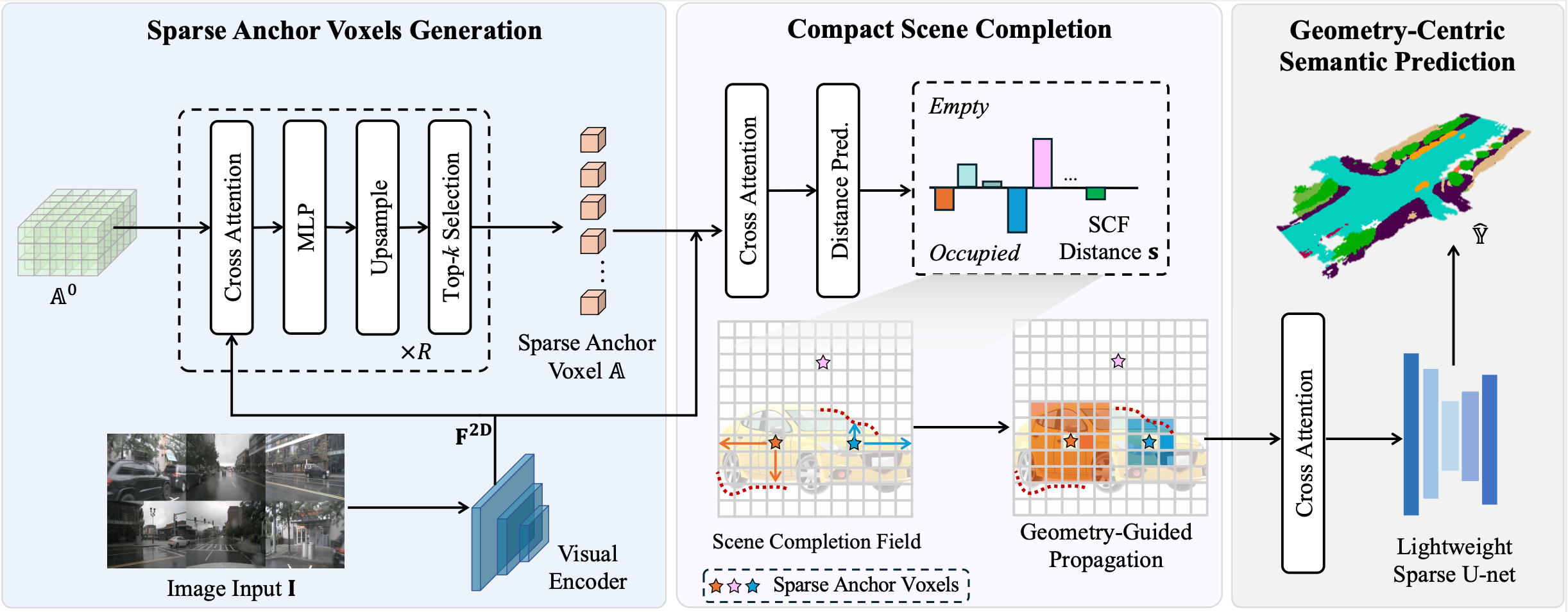
Overview of the proposed SparseOcc++. It first generates a set of sparse anchor voxels, which are employed as queries to gather features from images via deformable cross attention. To achieve compact scene completion, a scene completion field (SCF) is learned on these anchor voxels for efficient geometry-guided propagation. Finally, it employs a lightweight sparse U-Net to predict the final fine-grained semantic occupancy within the completed scene.
Experiments
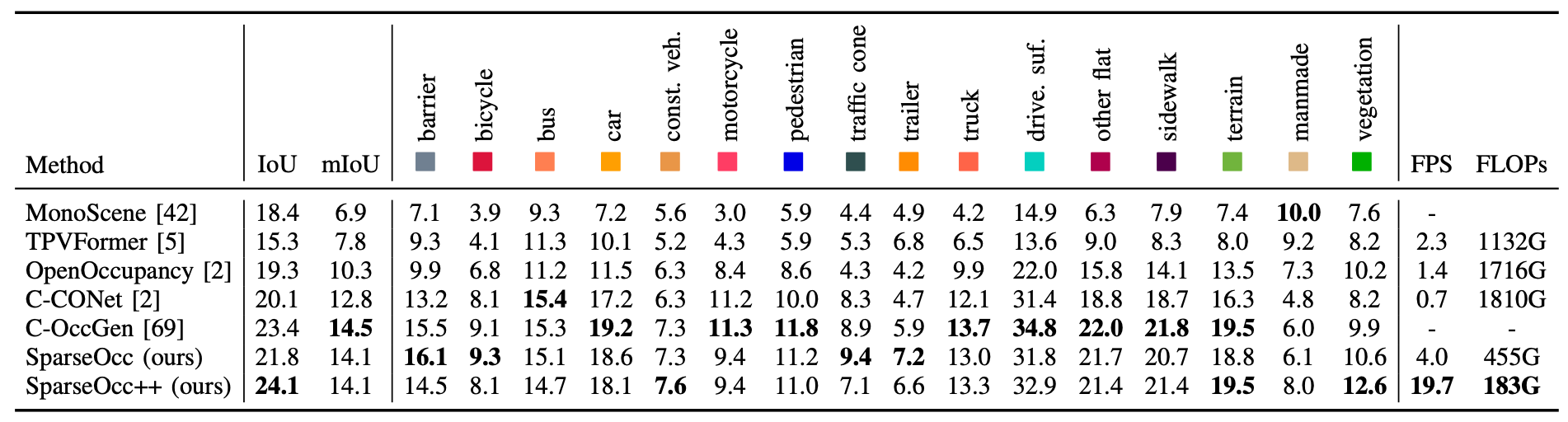
Semantic occpancy prediction results on nuScenes-Occupancy validation set. For accuracy evaluation, We report the geometric metric IoU, semantic metric mIoU, and the IoU for each semantic class. For efficiency evaluation, we report the FLOPs, training GPU memory, and 3D/overall inference latency. The C denotes camera and the bold numbers indicate the best results.
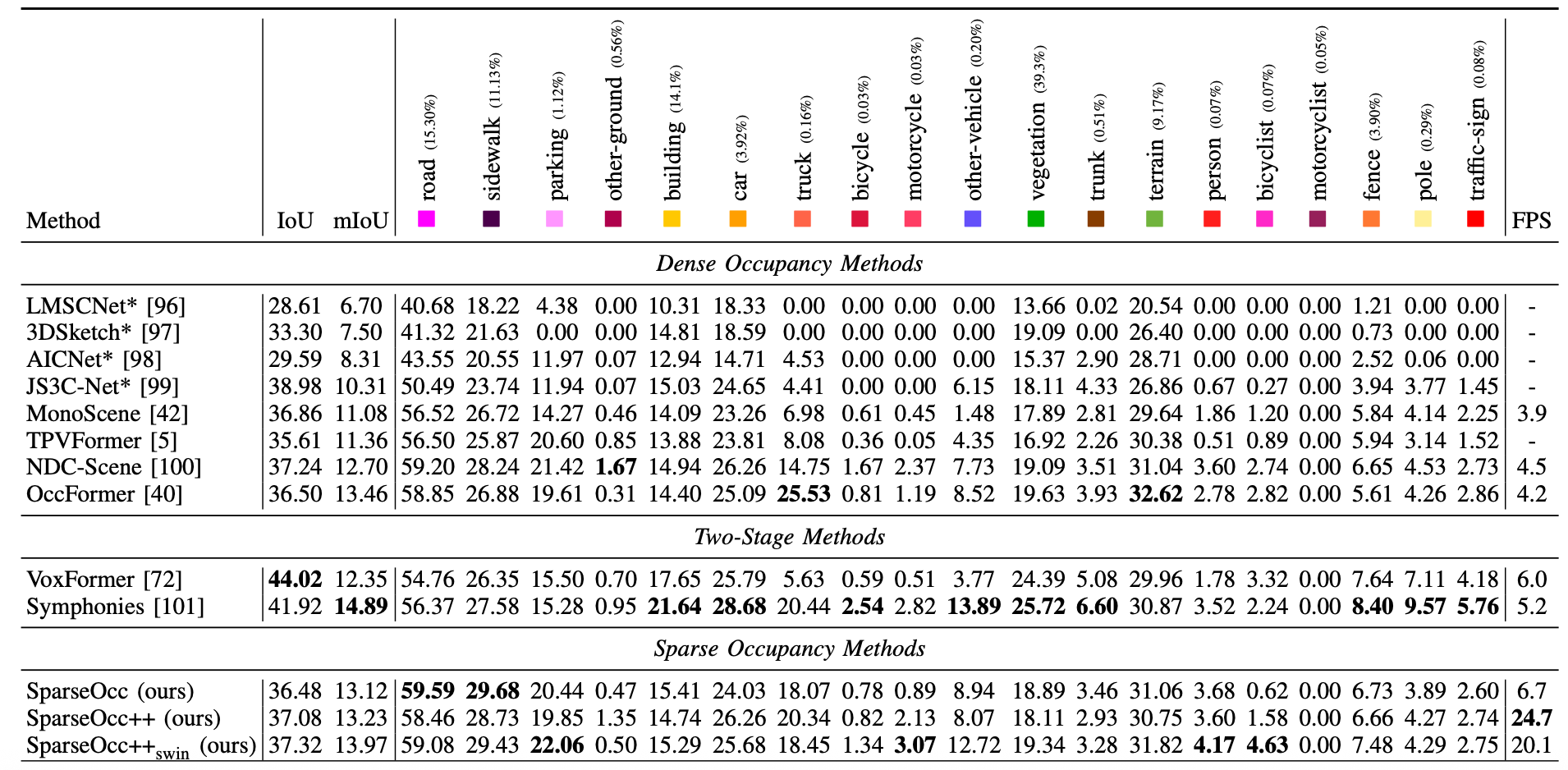
Semantic scene completion results on SemanticKITTI validation set. For accuracy evaluation, We report the geometric metric IoU, semantic metric mIoU, and the IoU for each semantic class. For efficiency evaluation, we report the FLOPs. The C denotes camera and the bold numbers indicate the best results. The methods with “*” are RGB-input variants reported by for fair comparison.
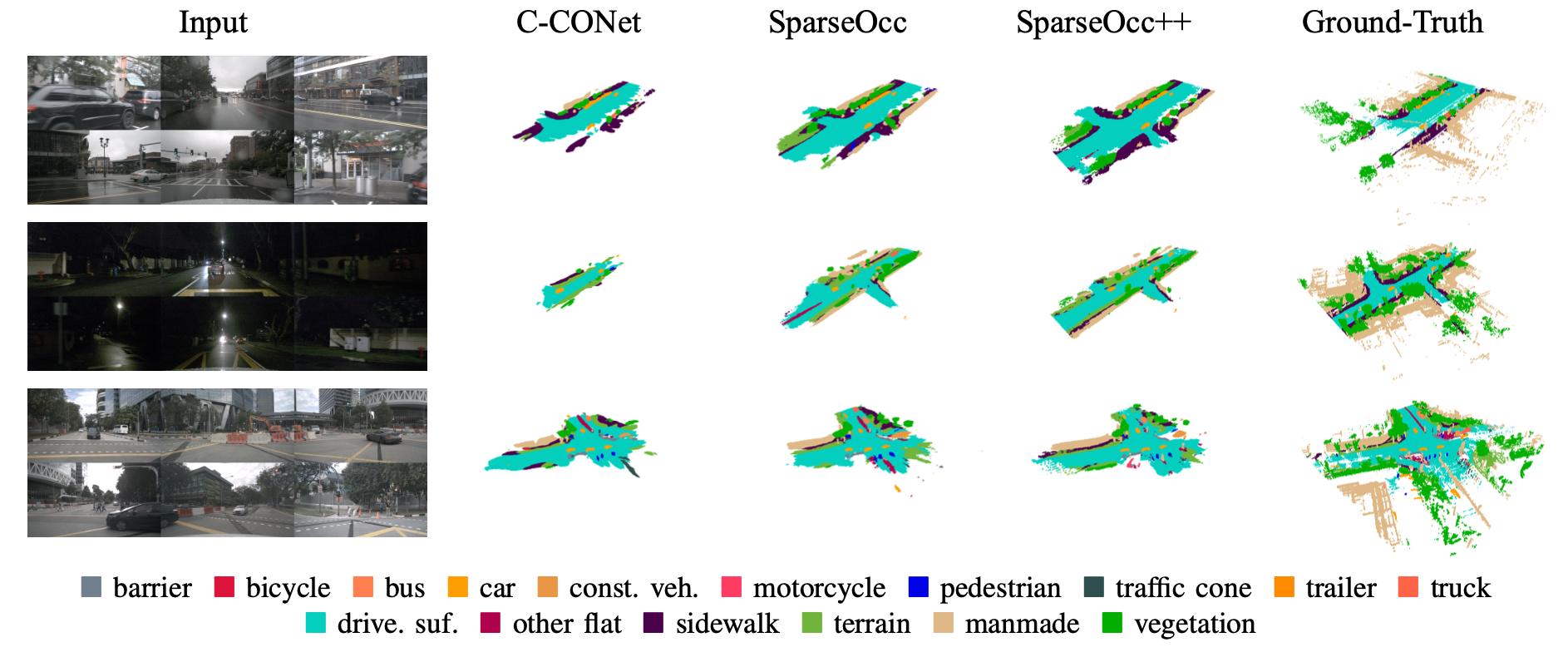
Qualitative results of 3D semantic occupancy on the nuScenes-Occupancy validation set. The input multi-view images are shown on the leftmost side, and the occupancy predictions of the dense baseline C-CONet, SparseOcc, SparseOcc++, and the ground-truth are then visualized sequentially. Compared to the 3D dense representation based C-CONet, our sparse representation achieves better completion and segmentation. The regions highlighted by rectangles show areas with noticeable differences. Best viewed in color and zoomed in.
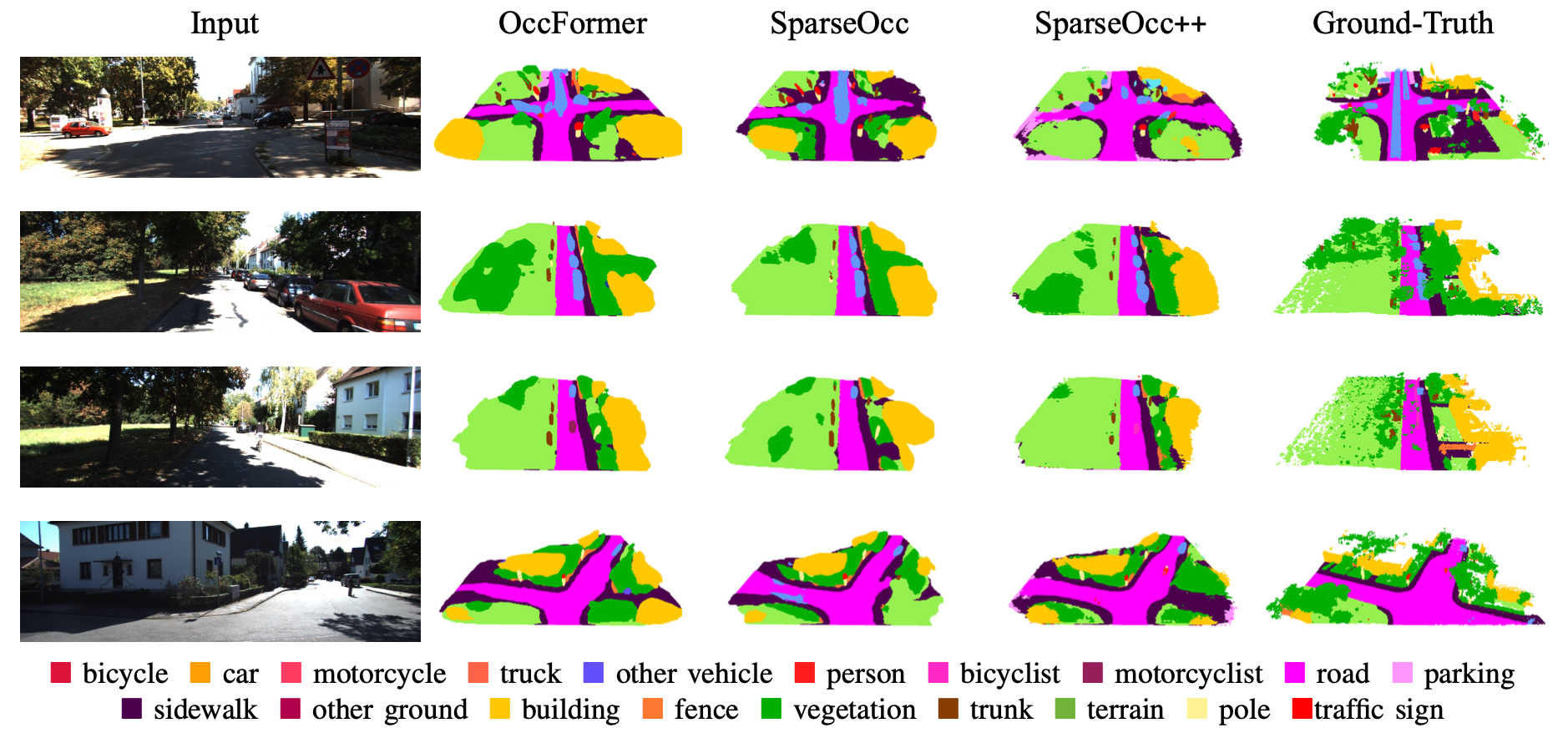
Qualitative results on the SemanticKITTI validation set. The input monocular image is shown on the leftmost side, and the 3D occupancy predictions of the dense baseline OccFormer, SparseOcc, SparseOcc++, and the ground truth are then visualized sequentially. The regions highlighted by rectangles show areas with noticeable differences. Best viewed in color and zoomed in.
BibTeX
      @inproceedings{tang2024sparseocc,
        title     = {SparseOcc: Rethinking Sparse Latent Representation for Vision-Based Semantic Occupancy Prediction},
        author    = {Tang, Pin and Wang, Zhongdao and Wang, Guoqing and Zheng, Jilai and Ren, Xiangxuan and Feng, Bailan and Ma, Chao},
        booktitle = {Proceedings of the IEEE/CVF Conference on Computer Vision and Pattern Recognition},
        year      = {2024}
      }